

The Crying Game: Quantic Dream's CEOs discuss their new PS3 game
need translation?
After announcing an exclusive deal with Sony to produce a new, unnamed PS3 title, Develop spoke to Paris-based Quantic Dream’s CEOs David Cage and Guillaume de Fondaumière (pictured) to find out more about their approach to games and life as a French games studio…
Firstly, what are you able to tell us about the new game?
David Cage: Our next project will continue to explore the direction we initiated with Fahrenheit. We discovered with Fahrenheit that an emotional experience based on storytelling could be as appealing as more traditional game forms. We also saw with the incredible reactions to The Casting [an E3 2006 tech demo] that people were eager to discover new forms of interactivity.
With this next project, we want to build on what we learnt, continue to improve the grammar of our narrative language, while offering a very unique type of experience. We continue to experiment, explore new ideas, push the envelope as far as we can and always try to surprise the player. It is again very ambitious, unique and challenging at all levels.
The Casting was as much about emotion as it was technology – is securing that kind of emotional investment from the player/view what defines ‘next-gen’ for you?
DC: Definitely. What else could ‘next-gen’ mean? More polys? Advanced shaders? Physics? What use are they for, if we just use this technology to create the same games as those over the past ten years?
Time has come for interactive experiences to propose more than fun and adrenaline. We need to offer a wide panel of emotions, and not just fear, anger, frustration, but love, hate, empathy, sadness. We should also start to bring depth and meaning by creating experiences deeply relating to a player’s inner self. Our industry is now ready to reach a more grown-up and wider audience. We will continue to produce games for teenagers, but not all people want to shoot and drive. It is now time for our media to reach maturity. We need to become more ambitious, more creative; we need to dare to explore new directions and to take risks. I am convinced that great rewards will be found following that route.
You drew inspiration from TV dramas, horror, and noir for Fahrenheit – what kind of source material is influencing your next project?
DC: Our next project is probably more personal. I continue to explore schizophrenia – what it means to be different persons – but the game will also be about love, fear, and how both can interfere. It will really be about moral choices, and the difficulty of knowing the difference between the good and the bad.
In a previous interview, you said The Casting represented a step away from the Uncanny Valley. Will developers always have to battle with issues of verisimilitude or are we close to creating a game that is as emotional and involving as any movie?DC: The Casting showed that the day was close where a virtual actor could express and share with the audience complex emotions. It was a short test done in three months starting from scratch, including the script writing and the development of the engine on PS3, but most of all it was about understanding from an artistic point of view what creating an emotional experience will mean in the future. On this point we learnt much more than what we expected. Thinking about a video game as an emotional experience has a massive impact on every single aspect of the development, from the writing and the interface, to the technology and tools. Quantic Dream has invested in this particular approach for ten years; we now have a very clear vision of how emotions can be triggered.
Quantic Dream has also been active in blurring the lines between story and gameplay and movies and interaction, as we saw in Fahrenheit – is that still a mandate for you? And is it something you will be pushing forward with your next project?
DC: I believe that the future of video games is to create complex emotions for a more mature and wider audience. There are many ways of creating complex emotions: Rez, Katamari Damacy, Ico or Final Fantasy are just some examples amongst many possibilities.
The direction I want to explore is to tell interactive stories, where the player through his actions can affect the way the story is told. I am interested in emotions, in emergent storytelling, in how the player can project himself in different characters and contexts, how we can make him laugh, cry, scream, feel empathy.
I am interested in storytelling because this is my personal sensibility, but also because I believe that this is a fascinating direction for this media in order to discover new forms of narration.
It is difficult, because there is no established format, technique or interface. It is challenging because we need to learn how to create this type of experience and to invent this new language, but it is definitely today the most exciting place to be when you want to be creative and to innovate.
The studio has been open for almost 10 years but only released two games – most independents can’t afford to take that long over a production. What’s your secret to making games you care about and have put plenty of effort into, but also stay in business?
DC: When setting up a company, I think you have to be clear about what type of company you try to create and what your goals are. Then every single decision you make should be consistent with the direction you choose.
I started Quantic Dream to be a pioneer in the field of emotion and storytelling, with the idea of contributing to make this media a mainstream entertainment form with high creative expectations.
We developed our own technology and tools, because we believed that the format we wanted to create would require unique and dedicated features. We bought a mocap studio because we thought that creating believable virtual actors would be of paramount importance, and that this knowledge would have to be discovered and controlled. We invested time and energy in discovering writing techniques and new types of interfaces suitable for interactive storytelling, because we wanted to create a format that would be really unique.
We structured the company in order to have the time and money to do these things properly, with the hope that these decisions would bear their fruits at some point.
I would say we are at present halfway down the road: Fahrenheit has been a fantastic opportunity to demonstrate what we believed in and it’s been incredibly received by both the gaming community and the industry. The Casting demo raised the industry’s attention; everyone in our business talks now about emotion as the next big thing, something we said and invested in for the past ten years.
Having said that, we have been incredibly lucky to always find people to invest in our ideas, but also to collaborate on exciting R&D projects and earn revenues from our mocap suite to keep us alive between two projects. Our main luxury was probably to have exclusively worked over the past ten years on our own concepts without having to make compromises ‘to eat’, which is also a sign in my mind that we have been on the right track all this time.
Is that why you signed with Sony?
Guillaume de Fondaumière: We are particularly proud to be expressing our vision in partnership with Sony Worldwide Studios. It is not only a great opportunity for us to be exclusive to the Playstation 3, to focus our efforts on one console that can truly deliver on our vision, but also to be working with people who entirely share our passion and ambition.
Having a mocap service is an interesting way to offset the long-term development business with a short-term contract one working for other companies. Was that the intention when you started offering motion capture to third parties?
GDF: The only way to reach the level of quality we were targeting with mocap and to produce the massive volumes of data required by our format for a reasonable cost was to own a system. It gave us time to work on R&D, try different solutions, and most of all, to integrate mocap in our pipeline properly, which very few studios in the world can do. Very quickly, the expertise we obtained interested other companies, and we started working for movies, commercials or games, which in turn contributed to our R&D by supporting our financial effort.
Quantic Dream has recently acquired the latest Vicon system, which will help further increase the level of quality and the productivity of the studio. This hardware associated with the experience we have now gives a real competitive advantage to the company to create emotional experiences based on virtual actors. We continue to invest massively in technologies and tools, as well as improving writing and directing techniques.
Do you think that’s a useful business model for other games studios going forward?
GDF: I am not sure one can really talk about a ‘business model’. Having an internal mocap studio was a strategic decision that was taken considering the very specific nature of our own productions. It is only a good solution if a given studio has a development strategy requiring mocap and the financial and human means to support it in the long run.
Has having a wide range of clients in that field from film, TV and advertising helped shape your game productions in any way?
GDF: As a video game developer, we have to find solutions to the particular constraints of real-time and research techniques and tools that are specific to our needs. Producing high-end animations for different media does contribute to the team’s overall experience as we must be aware of the latest technologies and uses in other fields, in particular motion pictures. In that sense, it helps shape our game productions because these collaborations contribute to blurring the line between films and games.
What are your thoughts on how tax credits have effected the French games industry?
GDF: Twenty years ago, Japan, the United States, Great Britain and France were producing most of the games that were sold worldwide.
Since the late ‘90s, the growing importance of video games as a cultural form of expression targeted towards the younger generations as well as its decisive contribution to research in a variety of technical and scientific fields has drawn the attention of other countries and they have invested massively to shape a local industry, sometimes from scratch.
Today, tax incentives and other direct or indirect subsidies are commonplace in most parts of Asia, in Australia, in Canada and in a number of states in the US. We know today that these initiatives are successful in shaping local markets but also attracting major publishers and some of the best talents.
Montreal has had a major impact on the French development scene and this will now certainly spread to other countries, in particular the UK, if the gap between the production costs in Europe and other parts of the world continue to widen.
We saw the problem coming five years ago in France. When our Government finally understood in 2005 how grave the situation was, we had lost almost 60 per cent of our workforce. I hope other Governments, in particular in the UK and Germany, will react swiftly now and help us present our case to the European Commission.
We have been negotiating with the EU since 18 months to obtain a 20 per cent tax credit in France – that is half of what Montreal offers! – but France alone can obviously not convince the Commission. If we don’t react swiftly, Europe as a whole will be hit by the brain and studio drain and there won’t be a vibrant European development scene anymore. This is a serious problem and we must stop hiding behind our ‘glorious past’.
And lastly, as president of APOM Guillaume, how would you say the French development sector has changed over the last few years?
GDF: I think the major difficulties we have faced in the past five years have had a major impact on our studios, both positive and negative.
More than 60 per cent of the workforce today is employed either directly or indirectly by Ubisoft. Most of the time, these studios work on a work-for-hire basis and not on original properties. This to me is a real problem as we all know the value of a company is drawn from its capacity to create, produce and retain interest in original IPs.
On the positive side, I see some very promising new studios emerge on a variety of segments, for instance on community based games for the internet, casual and serious games for PC and console or mobile phone games. We still do have a tremendous pool of individual talents in a number of fields. I also believe that the hard times we had to go through has had a very positive impact on our overall capacity to create true production value. French studios have become much more productive, organised and focused than they were five years ago.
I think it is the right time for international publishers to come back to France and establish some long term partnerships.
Autor: Michael French
Source: Develop
Language: English
Labels: David Cage, DevelopMag.com, Guillaume de Fondaumiere, Heavy Rain the Origami Killer (English), Interview English
 Tuesday, July 17, 2007
Sony Computer Entertainment Worldwide Studios to Work on a Groundbreaking New Title for PLAYSTATION®3
need translation?
Press Information For Immediate Release
Collaboration with developer Quantic Dream to redefine cinematic realtime entertainment
LONDON, July 3 2007 – Sony Computer Entertainment Worldwide Studios (SCE WWS) is pleased to announce that it will be collaborating with developer Quantic Dream on an exclusive PLAYSTATION®3 (PS3™) title – more details of which are to
be announced soon. Quantic Dream has an outstanding track record in delivering interactive, cinematic games with true emotional depth. Combined with the power of Cell Broadband Engine™ and game development technology of PS3, the project is expected to set a new benchmark in delivering emotionally compelling experiences to gamers.
Founded in 1997 by David Cage, French developer Quantic Dream has achieved international renown for its ground-breaking innovation within the games industry, particularly in the areas of interactive narration and emotional content. The studio’s
record speaks for itself: in particular Quantic Dream was responsible for 2005’s award winning Fahrenheit (known as Indigo Prophecy in the US and Canada), a paranormal, interactive blend of film and gaming that was widely praised for re-imagining the adventure game genre.
Michael Denny, Vice President, SCE Worldwide Studios, said:
“We’re really excited to be working with Quantic Dream for the first time and to have this opportunity to once again push the gaming experience to realise a new level of interactivity and, in particular, to engage players at an emotional level never experienced before. We’re looking forward to revealing more news on this special title later this year.”
David Cage, Founder, President and CEO of Quantic Dream, said,
“We always believed that “next generation” meant more meaningful content based on players’ emotional involvement. To us, PS3 is the only platform that can truly deliver on this promise, and SCE WWS is a group that is both inspiring and pleasant to work with.”
Autor: QD
Source: PDF copy of press release
Language: English
Labels: Heavy Rain the Origami Killer (English), Sony
Quantic Dream's Heavy Rain an emotional breakthrough
need translation?If you thought Keanu Reeves was wooden in Point Break, you should see the Nameless Marine. He doesn't say much, but he moves jaggedly, makes exactly the same sound each time he gets hurt, and always sports the same tense grimace. He is the worst actor you will ever see. Where can you catch him? Well, he's so bad he's only secured a role in a couple of titles, namely in id Software's DOOM series.
Chances are you haven't been too impressed by many other videogaming denizens. You'd think a character with whom you could interact freely would be more compelling than one in a world-class film, but this isn't the case. David Cage, lead designer of the upcoming Heavy Rain at Quantic Dream, attributes this to limited content.
"Most video games only use very basic emotions, like fear, anger, power, and frustration," he notes, "but not the social emotions that appeared later during evolution like empathy, sadness, joy, pity, love, et cetera. These emotions are more complex to generate, but all other art forms managed to do it. I can see no reason why games should limit themselves to the same old basic ones."
All art forms are, he believes, "emotional roller-coasters". "The pleasure we feel watching a movie or reading a book comes from the different emotions we go through," he elaborates. "There is no doubt in my mind that games will follow the same direction and offer more interesting, emotionally involving experiences, with more meaning and depth. Fahrenheit, our last game, was our first try at exploring new solutions. We will go much further with Heavy Rain."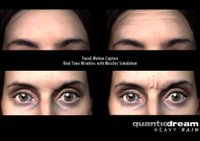
The first step was to secure adequate technology for the challenge, and they found it in PlayStation 3's resources. The result? A short trailer of sorts, shown at E3 2006. Unlike your typical gameplay walkthrough, Heavy Rain's trailer was simply in-game footage of an actress (voiced by Aurelie Bancilhon (Aurélie Brancilhon - correct.: UL), who also provided her likeness) auditioning for the role of a betrayed wife. Compared to the frantic gun battles and ninja duels shown near and around Heavy Rain, the trailer was uniquely affecting. And what's more, it expertly showcased the tech at Quantic Dream's disposal — the actress visibly went from being embarrassed, to nostalgic, bitter, suicidal, and, finally, enraged, with the kind of subtlety and depth usually only seen in, well, real people.
Cage explains why such an unusual trailer was used to promote his game: "'The Audition' was initially an internal prototype in real-time 3D on PS3 to help us understand the technical difficulties of creating an emotion actor. This demo was just our raw first try, without any R&D, and it was not supposed to be shown outside. When Sony saw it, they asked us if they could show it on their booth at E3, and this is how it all started. The demo has been downloaded 800,000 times on the internet, and Heavy Rain was, after E3, the most anticipated game on PS3 at GameSpot.
"Although we didn't plan for it to be shown, this trailer is indicative of the direction we will take regarding acting quality. The final quality of the game will be significantly higher, though. Also, this trailer is just a real-time non-interactive movie, where the game will be fully interactive, without cut scenes."
As well-received the Heavy Rain trailer was, there were complaints about its unprecedented realism. Some writers commented that because Quantic Dream has so closely approached photorealism, slight imperfections in the virtual actor — such as when the virtual Ms. Bancilhon's eyes seem glassy or when her lips are slightly out-of-sync — make the whole thing disturbing, rather than compelling. In other words, they argue that Heavy Rain suffers from the Uncanny Valley effect, where virtual humans almost perfectly mimic humanity but aren't quite perfect, and such imperfections are jarring. Players don't react this way to less sophisticated "fake" humans, as their humanity is abstracted and all "holes" are filled by our imagination.
Cage is disappointed that some chose to focus on what wasn't achieved in the trailer, rather than what was. "A lot of writers also wrote that this trailer was one of the first to put a step out of the Uncanny Valley," he remarks. "I think this is really an outdated discussion. There is absolutely no doubt that we will very soon have highly emotional and believable synthetic human beings. The technology and expertise are now in reach, and we could touch it in this prototype. The exact problem is that the closer you get to realism, the more it has to be perfect because the least imperfection becomes shocking. If you raise the quality bar, you need to do it in a consistent way on all aspects, which is the current technical difficulty. There are still issues, but again, we feel we are not that far anymore."
As long as Quantic Dream is consistent with its emotional sophistication — i.e., its game design and character development are just as advanced as its technology — Cage doesn't think such complaints will arise again. "They'll have no difficulty accepting virtual actors, as long as we remain consistent. We still need to work on some aspects, because very few people found solutions to reach this level of detail in an acting performance. For some major publishers, emotion in games is limited to a smile on the face of a golfer when he did a nice drive. With our trailer, we had a girl talking for four minutes, looking straight into the camera, in a kitchen and going from a naïve attitude to smiles, tears, and anger. This is a different type of challenge."
In his opinion, though, it's one that's fully achievable. Which begs the question: why hasn't a Heavy Rain been attempted before? "Most decision makers in this industry only consider concepts that have already been developed before," Cage shrugs. "When you try to come up with something really different, they look at you like you are (a) totally nuts, (b) an alien, or, (c) perfectly stupid. You know, 'Why try something different when we could sell so many GTA clones to these stupid teenagers out there?'
"At Quantic Dream, we try to have more ambition for our media. We were lucky enough to find publishers trusting our vision and giving us the means to accomplish it. After Fahrenheit, a project very few people believed in, a lot of publishers realised that it was possible to make games based on interactive storytelling and emotions. Some important ones think today that emotion and stories may be an interesting direction to explore and that the market starts to be ready for it."
It's fair to say that if you've seen Heavy Rain's trailer, you're probably more than ready for whatever Cage is creating .We may not know much about the actual gameplay — save that it furthers Cage's "Bending Stories" technique, a way of creating non-linear storylines, first used in Fahrenheit — but from what Cage has been suggesting, it doesn't look like it will play like anything we've ever seen before. And hopefully, the game will be successful enough to make emotion in games more than an afterthough. What's more, we'll be able to give the DOOM Marine the boot, once and for all.
(This is just a resume of facts we knew before, but Alexander research in short a complex of the future title. - UL)
Autor: Alexander Gambotto-Burke
Source: @Play
Labels: Heavy Rain the Origami Killer (English), News without news
Stagnation Anniversary
need translation?No news for last month about Omikron 2 Karma, no news about Heavy Rain and no news about Omikron source availability (fix link).
But site was updated in many internal links. They can't be found in latest news cause we posted it at the date of original writing. So just check one of game projects at the top green menu. Maybe you language translation available or some old information updated. Also fix Badalamenti music and Fahrenheit soundtracks links, there are no passwords and downloading problems.
Last time we have constantly problems with site forum. So I was seeking for a google stable suggestion for this one. Of course, nothing more better than Google Groups wasn't found. I'm still make no decision about creating there an our site group, cause interface is not very attractive and comfortable, but I was wondered to see there David Cage posts. Never think David was a spamer somedays ;). Don't believe me? Check this link for search results. Of course, it was in 1996 and early 1997, when the Quantic Dream was not yet registered, but Omikron game promotion was already linked to http://www.helios-scm.com/quantic (dead link now). Nothing interesting in this foundation, so we will not add this info to our site.
But interesting result. So much differences between that unknown spaming Quantic Dream and today world known french development game studio.
This year 2006 is a 10-year anniversary of Quantic Dream.
It's not official date, cause Quantic Dream site was found at 15 November 1996 and the first diary date was 7 October 1996. Quantic Dream registered in April 1997. But we can sure, that Omikron the Nomad Soul - first revolutionary project celebrates ten years that days.
Thanks David "Big Boss", Guillaume de Fondaumiere, David Bowie, Reeves Gabrels, Loic Normand, Thierry DoiZon and all people Quantic Dream Team for your hard working on all this cinema interacting games.
Related posts:
Autor: UL
Source:
Language: bad English
Labels: anniversary, Heavy Rain the Origami Killer (English), Omikron 2 Karma (English)
Mayrem Chat with David Cage
need translation?Maybe you can noticed a NEW! menu at the top of the main page. (moved to links - last edited)
This is a link to our French site friendly community.
Yeah, David Cage comes there to answer fans questions about Heavy Rain production and something more. The same way as it was with Fahrenheit (but JeuxVideo Forum used fo this). Thought it's a French speaking community, but you'll have no great problem asking in English.
As usual we try to collect forum posts at the site.
Old stuff Babble: I had intended to speak about a news according to which you had to publish the sources of TNS (Or perhaps tools of extraction, I do not know exactly of what it was a matter)... I have never succeeded in finding of official reference to this news. Therefore I wonder, was it a simple rumour?
DC: It is something of that it was extensively inside a matter. Game is now enough ancient so that we can librer source in the community to allow those who want to use them or to divert them.
We are going to make it, it is just necessary that they find the time to take a shovel and a pecker and to go to search archives to put everything online.
We are going to try to make this shortly...
kyllman: I read in an interview (which goes back to 2001 hein) that you had of racourcir (announced?) the end of NS but Eidos wanted that the play left for Christmas. Do you rappellez (?) yourselves in what the end would have been different?
DC:The end was much more complex initially. I had in particular provided that the player takes part in the revolution of Omikron and the final attack of the district of Ix by joining together the forces of Eveilles and of the people of Mayerem.
I have to be solved to mainly untie the history by kinematics instead of the epic attack which I had written…
Walkthrough Younes38: I am not the only one to ask me this question, namely or this finds this dear Vosda' N.
I reach every pixel in the game but did not find it, is it necessary to find him only be incarnated under a specific character, to have an unspecified object or with a certain part of the play?
DC: Frankly speaking, I do not have the least idea of it… It is that that starts a little to go up with far. I suppose that there is somebody on the Net which found the answer to your question. It is a little stupid, but the players remember the plays often better than what wrote them (or then, they so much were suffered to make that one tries to forget them.
Younes38: Quite simply: Can one open the cupboard in the room of Agatha? (Lucas says that it is closed with key)
DC: No one can open the cupboard. DC: The scene was designed to be more complex, but we chose to simplify it.
Fahrenheit vs. Omikron
E-Boz: ...can one laissezr go himself to regard Fahrenheit as a genesis of the world of Phaenon, Kushulainn would become thus the downward one of Lukas Kane and the Ix virtual conscience that the Demons controlled. Or even Boz is he a malicious impostor machiavelic who succeeded in seizing Omikron while being useful itself of confidence that eveilles carries to him… TNS would not be whereas the continuation of a gigantic confrontation between Oranges and the Mauves where the player would be only one pawn.
DC:Good, there are like you it changings very quite certain sets of themes common between NOMAD Soul and Fahrenheit. I suppose that there are things which return in what I have desire for expressing. I think that my principal topic turns around the identity, schizophrenia (reincarnation in NOMAD Soul, multi-characters and the loss of control of Lucas in Fahrenheit). E-Boz: ...do you have to think of Thelis with the character of Tiffany?
DC: For Tiffany, I actually thought of Telis. I suppose that there are psychoanalytical reasons with this character of woman well under all reports/ratios but which finishes badly… Complex of badly solved Oedipus?
All this being known as, one should not seek of another relationship between NS and F. Lucas Kane is not the back large father of Kayl; -)
Heavy Rain
UL:Heavy Rain wasl absent in Sony list of games. official E3 site E3 Insider still have no Heavy Rain on list. What was the problem?
David Cage:No issue. I guess they just forget the title... although it was number 1 of the most expected PS3 games on GameSpot for three weeks after E3...
UL:Heavy Rain. Is it final game? or just the technology name?
DC: Final title of the game... hopefully. UL: What's the story? Is it a sequel to Fahrenheit?
DC: The story is still secret and no, it is not a sequel to Fahrenheit.
UL: What's the difference in "capturing -> rendering" between Heavy Rain and Fahrenheit?
DC: Totally new engine on PS3. The MoCap is three times more defined, we used facial mocap and the rendering is HR with Normal Maps, Spherical Harmonics and post rendering. It is really another world...
UL:Why do you need AGEIA? as I know all physics motions can be resolved by CPU and Video chip, without any problem. Also first PC AGEIA chip products sees not satisfactory results.
DC: We use AGEIA technology on console for physics in general. There will be a version using their card and a version without the card on PC. Consoles versions will include physics without needing anything else, of course.
In the demo, physics manage Marie's hair.
UL: How much people working on it? Heavy Rain collect all people sources you have, or somebody works at the next game?
DC: Heavy Rain will probably need more than 120 people, some internally, other externally. We start a second team working on another project.
UL: When QD began to work on this project? year? two years? (this questions was during E3 2006 - comm: UL)
DC: For Heavy Rain, Feburary 06.
UL: Press release actress name and video titles differences in Second Name BRAncilhon versus BAncilhon. How right? Is it mistake?
DC: Aurelie Brancilhon. UL: Does QD canceled projects live in this new project? bLast, Quark... other?
DC: We usually start several projects at the same time. Over the last years, one of them get so much interest from publishers that we had to cancel or at least postpone the others. Each Quantic Dream's project requires up to 80 people and all our attention. It is difficult to start several original project with the same ambition in matter of quality...
kyllman: I read, that Heavy Rain, from its creation, will cancel TNS2, because Quantic could not work on the 2 projects at the same time.
DC:Mmmmm… It is a little more complicated than that…
Whereas the beginning of Fahrenheit, all the editors asked for why one wanted to make this odd play rather than one following NS, at the end of Fahrenheit, all the editors wanted Fahrenheit 2 and did not include/understand why one wanted to make NS2…
One embarked in-house on this demonstration of virtual actor while thinking of the two projects, and the feedback of the editors, the press and the community a little took us of short (600 000 remote loadings…).
Conclusion: temporary pause on NS2 time that HR correctly is launched, but it is in the plans of launching a second project in the months which come.
General
E-Boz: In fact my question is simple: why do you make video game, Mr. Cage?
DC: Why I make video game? Parce interactivity and real time are a new exciting mass media which is going to allow to create new emotions. It is also siily as this. I one am not frustrated of cinema, I like interactivity and I chose this mass media rather than other one intentionally, even if I try to employ it in another way.
What interests me, it is to participate in the creation of this new language. It is surely the most exciting adventure that an inventive can live at present. I search new words, new codes.
With their qualities and their defects, I hope that TNS and Fahrenheit bring each something once again.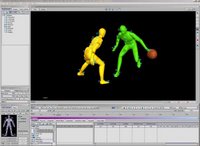 E-Boz: You make me think of Serge Gainsbourg... " In the French song, it is necessary to invent a new language, a new sonority the French song is to invent. "
And I wish you a similar parcour because you have all that is needed for.
Admirer's word!
It what titille me is précisement the fact that you want to create a new language. But they want to create a new language only if they want to express something that cannot be satisfied with already existing languages. Otherwise they speak to say nothing.
What do you therefore want to express that you cannot say otherwise than by video game?...
That has t-il therefore in the bottom of you there that you want all to say to us we, the players who penetrons your world at your invitation?
DC:I really do not have message which I try to reveal in the planet across my "work".
I think that I am very interested by schizophrenia, question setting on why they are the one what they are, what this makes to be somebody else.
It is themes which seems to come back regularly in my work without that I try to cause it (the change of body in Nomad Soul, Lucas Kane who kills dnas a second state and the possibiité to control several figures all at once in Fahrenheit).
No idea of the source of my interest for schizophrenia, I obviously do not suffer from it (unless I do not know it).
I think that interactivity is ideal mass media to recall this topic.
UL: Do you really think a very expensive Motion Capture can concurrent with some mathematics modeling of people moving? Cause it's not very difficult to write an algorithm of man's moves, and using some sources like Havok engine may be not simple, but real.
DC: Mmmmm, it is unfortunately not as easy. There is no algorithm of human move and I don't think we will see that in the coming years. Physics is great for rag doll for example and there are some great technologies merging animations with physics, but you always need mocap animations at the start. MoCap is by far the fastest, cheapest and higher quality you can get.
UL: Also as I know AGEIA technology use HAVOK engine too, so why you need capturing and not simply sit and write moving scripts?
For example looking for the game world (thought I'm just a gamer) I see Movies and Games future without real actors at all.
DC: Some confusing here. HAVOK and AGEIA are two totally separate technologies. Again, there is no "moving scripts" in any of these technologies or in any tehcnology I know. You always need key framed or mocap animations.
UL: About developers diary. It was very interesting to read David's notes at the site, when I began to look for Omikron project in 97.
Fahrenheit has a postrelease developer diary posted at unknown site. (1UP). Yeah I know you work hardly you have no time to write, but may be other QD team members want to write? Can we hope to see the stages of Heavy Rain and Karma ?
DC: I would love to, but it really takes a lot of time. Once my writing work is finished on Heavy RAin, I may consider writing a blog again...
Meanwhile, there is a very long post-mortem of Fahrenheit on Gamasutra.
UL: Quantic Dream has more popularity in game industry after Fahrenheit release, and what about cinema industry, how they react?
DC: Very well... but I cannot say more for the moment ;-)
Want read more. Be at our news pulse.
Else welcome to the French community site Mayerem, but before you living Onikron Game site read answers for your question, not to ask already answered. Just type in search what you want.
Sorry for English. Some posts was cutted. ;) - UL
Source: Mayrem
Labels: David Cage, Heavy Rain the Origami Killer (English), Interview English, Omikron 2 Karma (English), Omikron Nomad Soul (English)
Previous News
- Detroit: Become Human
- Настоящий дефектив. Чем плоха расхваленная Heavy R...
- Beyond: Two Souls review: Beyond awful
- The Dark Sorcerer – a next gen comedy from Quantic...
- The Dark Sorcerer
- QD stories and projects not interesting anymore
- PlayFrance: interview David Cage
- [FJV 2009] Heavy Rain : Interview exclusive P3L de...
- Podcast: Kombo Breaker - Episode 45: Heavy Rain In...
- CVG: Heavy Rain delayed because it "needs space"