

Nomad Soul Credits
- Written and Directed by

David Cage - Founder, President of the Board of Directors As a professional musician, David creates TOTEM INTERACTIVE in 1993, a company specialized in sound and music productions. Works as a freelance on original soundtracks for several video games for publishers such as Sony, Psygnosis, Virgin, Cryo or Sega. Writes sci-fi short stories and novels.Founds Quantic Dream in 1997. Game designer and writer of Omikron - The Nomad Soul and Fahrenheit.David is the creator of some of the most innovative concepts in video games of the past years.- Project Manager:
- Olivier Demangel
- Internal Producer:
- Anne Devouassoux
- Designs and Graphics:
- Loic Normand
- Lead Graphists:
- Stephane Elbaz
- Philippe Aballea
- Olivier Demangel
- Edouard Pham
- Xavier Malard
- Eric Seigaud

Pierre Roux - Creating settings for Quark, a fantasy RPG/Adventure title in real-time 3D. Also currently a game analyst on Omikron at Quantic Dream.- Nathalie Chody
- Tsoa Rakotoarisoa
- Kamel Gali
- Franck Aubessard
- Amar Hamidi
- Corentin Jaffre
- Yann Legal
Thierry DoiZon Quark Art Director - not Omikron
- Programming:
- Olivier Nallet
- Fabien Fessard with
- Frederic Hanoulle
- Antoine Viau
- Francois Kermorvant
- Stephane Fournier
- Julien Varnier
- Christophe Vivet - Lead Engine Equipped with a mathematics and physics diploma and a computing management diploma.Started working in 1997 as a Junior Developer for "Shen technologies", a video game developer. Worked on Adidas Power Soccer 2 and Adidas Power Soccer 98 for PlayStation and PC for publisher Psygnosis, a Sony subsidiary.Joins Quantic Dream in 1998 as a Senior Programmer for Nomad Soul on PSX, Dreamcast and PC.Became Lead Programmer in 2000 for Fahrenheit, in charge of the development of the 3D engine technologies
- Jean-Charles Meyrignac
- Animations:
- Tony Lejuez
- Christophe Leulier
- Xavier Malard
- Yan Le Gall
- Bernard Bittler
- IAM Scripting:
- Sophie Buhl - Lead Game Builder Equipped with a PhD in Banking and Finance.Joins Totem Interactive in 1993 as commercial and marketing manager.Joins Quantic Dream in 1996 as lead scripting (level design) on Omikron - The Nomad Soul.
- Nathalie Chody
- Audrey Leprince
- Cameras:
- Daniel Cinglant old site
- David Cage
- Dialogue:
- Christophe Leulier
- Tsoa Rakotoarisoa
- Marie Catherine Herveau
- Anne Devouassoux
- Regis Carlier
- Sound Effects, Ambient & Additional tracks:
- Xavier Despas
- Original English Voices:
- David Bowie
- David Gasman
- Paul Bandey
- Karen Strassman
- Christian Erickson
- Barbara Weber
- Gay Marshall
- Edward Marcus
- Allan Wenger
- Joe Rezwin
- Patrick Floersheim
- Iman 1631:

Iman- The Dreamers:



- David Bowie
- Reeves Gabrels
- Gail Ann Dorsey
- Sound Enginner:
- Jean-Jacques Toroella
- Original Songs and Soundtracks:

David Bowie & Reeves Gabrels- Facial Lipsynching and Dialogue Motion Capture:
- Tribu
- Motion Capture Acting:
- Marc Chung
- Minh Minh Ngo
- Pascal Gentil
- Emmanuelle Parlant
- Tony Dehas
- Body Motion Capture by:
- Acti System
- Mr Bowie’s Motion Capture created & performed by
- Edouard Locke
- Producer:
- Herve Albertazzi
- Producer (US)
- Tom Marx
- Senior Designer:
- Philip Campbell
- Additional Support:
- Paul Glancey
- QA Manager (UK):
- Tony Bourne
- QA Manager (US):
- Michael McHale
- QA Project Co-Ordinator:
- Dominic Berzins
- Senior Tester (UK):
- David Rousseau
- Testers (UK):
- Nicolas Gianel
- Guillaume Petit
- David Asenkat
- Jonathon Redington
- Tyrone O'Neil
- Linus Dominique
- Jonathan Arday
- Alexandre Lepoureau
- Lead Tester (US):
- Clayton Palma
- Testers (US):
- Chris Lovenguth
- Pierre Roux
- Corey Fong
- Greg Rizzer
- Lars Bakken
- Carissa Shubb
- Robert Swain
- Compatibilty Testing (UK):
- Jason Walker
- Compatibility Testing (US):
- E. Mark Smith
- Localization:
- Holly Andrews
- Flavia Timiani
- Development Manager (Europe):
- David Rose
- Development Manager (US):
- Nicholas Earl
- Product Manager (UK):
- Michael Newey
- Product Manager (US):
- Susan Boshkoff
- Product Manager (Germany):
- Marcus Berhens
- Product Manager (France):
- Olivier Salomon
- PR (UK):
- Jonathan Rosenblatt
- Steve Starvis
- PR (US):
- Brian Kemp
- PR (France):
- Priscille Demoly
- PR (Germany):
- Sascha Green-Kaiser
- Special Thanks To:
- Eric W. Adams
- Lee Briggs
- Charles Cornwall
- David Cox
- Nick Davies
- Rob Dyer
- Robert Goodale
- Frank Hom
- John Kavanagh
- Mike Kawahara
- Debbie Lash
- Ian Livingstone
- Mike McGarvey
- Matthew Miller
- Rose Montgomery
- James Poole
- Jo Kathryn Reavis
- Mike Schmitt
- Rebecca Shearin
- Paul Sheppard
- Eva Whitlow
- William Zysblat
- Janey de Nordwall
- Manual:
- Carol Ann Hanshaw
- The Write Stuff
- QUANTIC DREAM WOULD LIKE TO THANK:
- John for his faith. Bruno for believing when there really was no reason to. Iman, David and Reeves for their enthusiasm, their talent and their intelligence. Charles for accepting the challenge. Philip for his support and enthusiasm. Eidos and Eidos, France. Tony and Ed for the quality of the casting and devoting so much time to us. All the people that sent us encouraging e-mails and supported us from the start. Our wives and girlfriends for being patient and understanding. All the staff at Quantic Dream for the sleepless nights and the long week-ends.







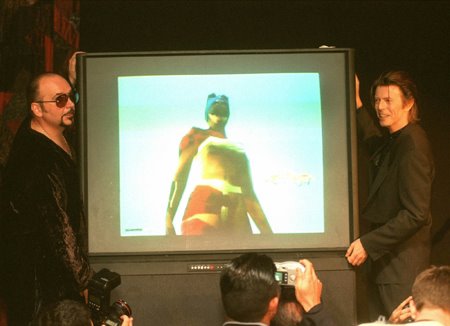








 Tuesday, August 31, 1999
Games First Preview
need translation?You know that any video game that has anything to do with David Bowie is going to be . . . ah, interesting. From his early incarnation as Ziggy Stardust to his Berlin period with Eno and Iggy to his work in such films as Roeg’s The Man Who Fell to Earth, Bowie has been riding the cutting edge for most of his protean career, fearlessly bending both gender and genre. So it seems fitting that Eidos and Quantic Dream’s Omikron, a game that Bowie wrote eight songs for and in which he will appear as the character Boz, is also a cutting-edge genre-bender. Though billed as a 3D action-adventure game, Eidos claims that it will incorporate "adventure, exploration, action, combat and role playing elements." Omikron will also implement such original features as facial motion capture in real-time, and will contain more than 400 different sets in four huge cities, 140 characters that move in 3D real time, and over four hours of dialogue.
The game’s premise is that the player suddenly finds their soul projected to a different dimension and into a new body. Of course, the player will have no inkling of why this happened, and the game consists of unravelling the mystery of why it did. To do so, the player must scour the city of Omikron in search of deliverance. To win the game the player will have to engage in a myriad of activities, including conversing, fighting, shooting, and driving. Though most of the game will be played 3rd person view, 1st person will be used for shooting. Omikron’s designers pride themselves upon the game’s non-linear play; the player will be allowed complete freedom of movement in the massive real-time world of Omikron, and will be able to enter any building (provided they are welcome) and talk to any character at any time.
One of the game’s coolest features (and one it shares with Messiah, another highly-anticipated game) is what it calls "Virtual Reincarnation." If the body that your nomad soul inhabits is killed, your soul will automatically transmigrate into the next person that touches the corpse. This will allow players to play in several different bodies (including that of Bowie’s supermodel wife, Iman) in each game, and each body will have different abilities. And there have been some hints that you will be able to improve, RPG-like, these abilities.
Omikron also seeks to push the technological envelope. It will be the first game to use real-time facial motion capture, and will contain within it a fighting game that includes 3D motion-captured fighting moves modelled from real-life martial arts champions.
Ah, and the music. David Bowie and Reeves Gabrels have created original music for the game, including eight new songs. In the game, you’ll be able to catch Bowie (as his character Boz) performing these songs in bars throughout the city of Omikron, and you can even purchase the "virtual album" of the music in-game, take it back to your virtual apartment, and kick back with a virtual beverage while virtually chillin’. We haven’t heard any of the tracks yet, but they promise to be—as one would expect from Bowie—different from the norm. According to Bowie, "I moved right away from the stereotypical industrial game music sound. My priority in writing music for Omikron was to give it an emotional subtext. It feels to me as though Reeves and I have achieved that."
Omikron looks like one of the most ambitious, gorgeous, and intriguing games of the upcoming year. If it can pull the many genres it attempts to span into any sort of coherent whole, it could be one of the most successful as well.
We’ll see when the game is released this Fall.
preview: Eidos
CDMAG Preview
need translation?Putting the "adventure" back in Action/Adventure
Published by Eidos
Okay, action fans—I've heard you admit it. "Gee, it sure would be nice if there was a little more story to this shooter." And hardcore adventurers? You've been kvetching for years about the evils of most action hybrids. "They're stuffing the genre with shallow, twitchy box-stacking sims." So it should be interesting to see whether Eidos' upcoming 3D action/adventure Omikron manages to please both camps. Omikron seems to be, at its grafted little hybrid heart, a game with both punch and puzzles.
Its story looks pretty variable—an oddly coherent mishmash of sci-fi and mysticism, subtle investigation and direct force, hackneyed setups and highly unique twists. For example, there's little shock in the fact that you'll be playing a cop. Heck, it's practically a time-honored game tradition. But this time, wait, you're not actually a cop—you're really… you. As a computer user from planet Earth, you've personally been asked by Security Officer Kay'l to help save the city of Omikron. And to travel to this parallel world, you'll have to electronically transfer your soul into Kay'l's virtual body.
Don't be so surprised—in the high-tech, Orwellian city of Omikron, computers can do marvelous things, such as digitally storing inventory items, flawlessly directing a crowded traffic grid, and carefully controlling every aspect of human behavior and society so that Omikron's residents display an acceptable average level of happiness and productivity. (Paranoia fans, just repeat to yourselves, "be happy, citizen—the computer is your friend!") Compared to such feats of technological wizardry, what's a simple soul upload? Child's play.
Once you step through the portal to Kay'l's world, you'll be attacked by a demon, saved by a 'mech, introduced to the essential creepiness of an over-regulated society, treated to a really spiffy theme song, and seduced by a woman who claims to be your wife. All within the first ten minutes of gameplay. With these opening pleasantries out of the way, your situation devolves rapidly into murder, suspicion, betrayal, and conspiracy.
Riddle me this
As befits a true adventure, much of the story will be carried through dialogue with other characters. You'll have to chat with many folks to build a clear impression of the world you're trying to save. In addition, the traditional inventory-based puzzles (give the reptile chow to the lizard so that it will fetch you a key) seem well represented in this title, despite its 3D-accelerated, dark-landscaped, pop-icon-scored resemblance to a hardcore action game.
This is not to say, of course, that action fans won't find their share of real-time mayhem in Omikron. Remember, you'll be playing a futuristic cop, and they have hostage situations for breakfast.
Hand-to-hand combat seems fairly straightforward—once an enemy approaches, your perspective will rotate to a side view reminiscent of many console fighting games. The joypad keys are then reassigned from their usual functions to a variety of physical moves, and pressing combinations of these action and movement keys will create some of the elaborate martial arts attacks we've all grown to know and envy.
Firearm combat, on the other hand, will be handled a bit differently. Whenever you enter an enemy's range, the normal third-person, Tomb Raider-esque interface will be replaced with a first-person view, complete with little red crosshair in the center. The trick, of course, is simple—make sure the bad guy is targeted, then shoot him.
To prevent frustration, training areas will be available for both flavors of combat, giving traditional adventure players a chance to get used to the concept and console action junkies an opportunity to see how the controls differ from whatever they might have played yesterday.
Nuts and bolts
Of course, if the residents of an otherworldly city are going to ask to borrow your soul, they'd better make the trip worthwhile—no cheesy graphics, no endless string of box-filled warehouses, no B-movie voice acting. From what we've seen so far, Omikron definitely delivers. The domed city is a brooding, darkened place, employing the game's proprietary 3D indoor/outdoor engine to create a Max Headroom-like atmosphere. Advertising signs light patches of featureless sidewalk, police 'mecha keep a wary eye on passing citizens, and the building interiors are beautifully tailored to their function and the status of their owners. A definite sense of "have and have not" becomes eerily apparent when comparing the apartments of Kay'l the cop and a cargo worker he's sent to interrogate.
Those who serve the system are rewarded. Huxley would be proud.
The game's interface seems extremely simple, allowing the entire range of movement and actions to be selected via a PC gamepad. An imaginative piece of fiction lends in-game credence to the elementary controls—each resident of Omikron wears a wrist-mounted computer called a Sneak, which ties into the city's central computer and allows them to access various basic functions. By using this device (or, in real-world terms, by pushing the M button on your gamepad), you can access your personal log, call a taxi to any useful destination in the city ("spent" locations will disappear from the list), use any mystical rings you may have (to save the game), or check your inventory items, which are allegedly digitized into the Sneak when you pick them up. Although the number of inventory slots is limited, items can be transferred to the city's networked storage system, Multiplan, and saved until needed.
Non-gamepad users should be able to get by with a set of keyboard commands, but currently the gamepad seems to be the more effective choice for easy control. Either way, though, Omikron promises easy accessibility to anyone who has played a console RPG or fighting game.
The soundtrack is equally noteworthy. In an attempt to both create an unearthly musical environment and maximize the mass-market potential of the game, Omikron's creators went straight to the top—perennial rock star David Bowie. Rather than licensing a selection of pre-existing songs, however, the team quickly found themselves talked into an entirely new collection of music by a very enthusiastic Bowie. Aside from contributing his very considerable musical talent to the project, the former Ziggy Stardust also appears in Omikron as a digitized freedom fighter.
Death, and the art of saving games
Impressive and entertaining as the game may look at this early beta stage, there is nonetheless one worrisome factor to consider—Omikron might be trying a little too hard to resemble a console title. Sadly, this consolewannabeism is a common malady among action/adventures, and Omikron exhibits its most classic symptom—restricting the player to pre-determined "save points".
The game's most fascinating feature, however, might help to compensate for the savegame limitation. This is Omikron's central concept—that you, as the player, are really the "soul" of your machine. So if one character falls victim to your ill-considered actions, you should simply be able to move on and find another virtual host. (Assuming, of course, that the high-tech medics of Omikron City can't just save your borrowed butt with their handy regeneration beams.)
With any luck, Omikron may be the first game to make frequent saving not merely unnecessary, but actively uninteresting. After all, you never know when the next available body might have all the… features… you've been craving.
Autor: Cindy Vanous
Source: CD MAG
Previous News
- Detroit: Become Human
- Настоящий дефектив. Чем плоха расхваленная Heavy R...
- Beyond: Two Souls review: Beyond awful
- The Dark Sorcerer – a next gen comedy from Quantic...
- The Dark Sorcerer
- QD stories and projects not interesting anymore
- PlayFrance: interview David Cage
- [FJV 2009] Heavy Rain : Interview exclusive P3L de...
- Podcast: Kombo Breaker - Episode 45: Heavy Rain In...
- CVG: Heavy Rain delayed because it "needs space"